

Writing has changed dramatically in the digital age. Today, writers are expected to produce high-quality content faster than ever, while maintaining clarity, originality, and relevance. This challenge has led to the widespread adoption of AI writing tools—intelligent assistants designed to support, not replace, human creativity.
For bloggers, students, marketers, and digital creators, AI writing tools can streamline the entire writing process. From brainstorming ideas and structuring outlines to refining grammar and improving readability, these tools act as powerful productivity amplifiers. This evergreen guide explores some of the most reliable AI writing tools available today and explains how they can be used responsibly to support consistent, high-quality content creation over time.
Why AI Writing Tools Are Becoming Essential
The demand for written content continues to grow across blogs, academic platforms, business websites, and social media channels. At the same time, competition for attention has intensified. Readers expect content that is clear, useful, and easy to consume.
AI writing tools help writers manage this pressure by handling repetitive and time-consuming tasks. Instead of struggling with blank pages or endless revisions, writers can focus on ideas, storytelling, and value creation.
Main Benefits of AI Writing Tools
- Faster drafting and editing workflows
- Improved grammar, sentence flow, and clarity
- Support for long-form and short-form content
- Better organization of complex topics
- Reduced writer’s block and mental fatigue
When used carefully, AI enhances writing quality rather than diminishing it.
Related insight: How AI Tools Are Revolutionizing Productivity
1. ChatGPT

Best for: All-purpose writing, brainstorming, and drafting
ChatGPT is one of the most versatile AI writing assistants available today. It can support a wide range of writing tasks, including blog posts, academic explanations, summaries, creative writing, and content rewrites.
Its conversational design allows writers to interact naturally, refining ideas through dialogue rather than static commands. This makes it especially useful during the early stages of content creation.
Key Capabilities
- Generates natural, human-like text
- Adapts tone and complexity based on prompts
- Excellent for outlines and long-form drafts
- Can simplify complex or technical topics
Strengths
- Highly flexible across different content types
- Strong contextual understanding
- Useful for both beginners and experienced writers
Limitations
- Output quality depends on prompt clarity
- Advanced features may require a paid plan
Ideal for: Bloggers, students, and creators who want a single tool for ideation, drafting, and editing.
Official site: https://chat.openai.com/
2. Jasper AI
Best for: Marketing content and brand consistency
Jasper AI is designed for marketing professionals and businesses that need to produce content at scale while maintaining a consistent brand voice. It emphasizes conversion-focused writing rather than general-purpose text generation.
Jasper’s structured templates make it easier for teams to create ads, landing pages, and promotional content without starting from scratch.
Key Features
- Pre-built templates for blogs, ads, and emails
- Custom brand tone and style settings
- Collaboration tools for teams
Advantages
- Strong focus on persuasive writing
- Useful for scaling marketing operations
Drawbacks
- Higher pricing than general AI tools
- May feel complex for casual users
Ideal for: Businesses and marketing teams producing high-volume content.
Official site: https://www.jasper.ai/
3. Copy.ai

Best for: Short-form copy and quick marketing content
Copy.ai focuses on speed and simplicity. Instead of long-form articles, it excels at generating concise copy such as social media captions, product descriptions, and promotional text.
This makes it especially attractive to entrepreneurs and small teams that need fast results without a steep learning curve.
Key Features
- Ready-to-use copywriting templates
- Beginner-friendly interface
- Free plan available for basic use
Limitations
- Limited flexibility for long-form writing
- Not suitable for academic content
Ideal for: Social media managers, startups, and solo entrepreneurs.
Official site: https://www.copy.ai/
4. Grammarly
Best for: Editing, grammar correction, and tone refinement
Grammarly differs from other AI writing tools because it focuses on improving existing text rather than generating content from scratch. It acts as an intelligent editor that helps writers polish their work before publication.
By identifying grammar issues, awkward phrasing, and tone inconsistencies, Grammarly ensures content looks professional and credible.
Main Features
- Real-time grammar and spell checking
- Clarity, conciseness, and tone suggestions
- Plagiarism detection in premium versions
Strengths and Weaknesses
- Strengths: Excellent for final proofreading and editing
- Weaknesses: Limited creative and drafting capabilities
Ideal for: Students, professionals, and writers preparing final drafts.
Official site: https://www.grammarly.com/
5. Writesonic
Best for: SEO-focused long-form content and product descriptions
Writesonic is designed for writers who want their content to perform well in search engines while remaining readable and structured. Unlike simple copy generators, it supports long-form articles, landing pages, and e-commerce descriptions with an emphasis on keyword relevance and formatting.
For bloggers and affiliate marketers, Writesonic can act as a foundation tool—helping generate structured drafts that can later be refined with human insight.
Key Features
- Long-form article and blog generation
- SEO-oriented writing workflows
- Support for multiple content formats
- Headline and paragraph variation tools
Strengths
- Helpful for targeting organic traffic
- Provides structure for long articles
- Good balance between speed and control
Limitations
- Output quality depends on input quality
- Credit-based usage may limit heavy users
Ideal for: Bloggers, niche site builders, and e-commerce marketers.
Official site: https://writesonic.com/
6. Frase
Best for: SEO research, search intent analysis, and content planning
Frase is less about writing sentences and more about planning content that ranks. It analyzes search engine results pages (SERPs) to uncover what top-performing pages are covering—and what they are missing.
This makes Frase especially valuable during the planning stage, before a single paragraph is written.
Main Capabilities
- SERP analysis and competitor comparison
- Search intent identification
- Content gap discovery
- Outline and topic cluster planning
Why Frase Matters for SEO
Search engines prioritize content that fully answers user questions. Frase helps writers understand:
- Which subtopics are commonly covered
- What questions users are asking
- How deeply competitors explain a topic
Ideal for: SEO specialists, content strategists, and agencies managing large content libraries.
Official site: https://www.frase.io/
7. Sudowrite
Best for: Creative writing, fiction, and storytelling
Sudowrite is built specifically for creative writers. Rather than focusing on SEO or marketing, it helps develop stories, characters, and scenes by offering imaginative expansions and prompts.
This tool is especially useful for overcoming creative blocks and exploring alternative narrative directions.
Key Creative Features
- Scene expansion and rewriting
- Character development assistance
- Plot exploration and brainstorming
Limitations
- Not suitable for academic or business writing
- Limited usefulness for SEO-driven content
Ideal for: Novelists, screenwriters, and fiction writers.
Official site: https://www.sudowrite.com/
Recommended AI Writing Workflow
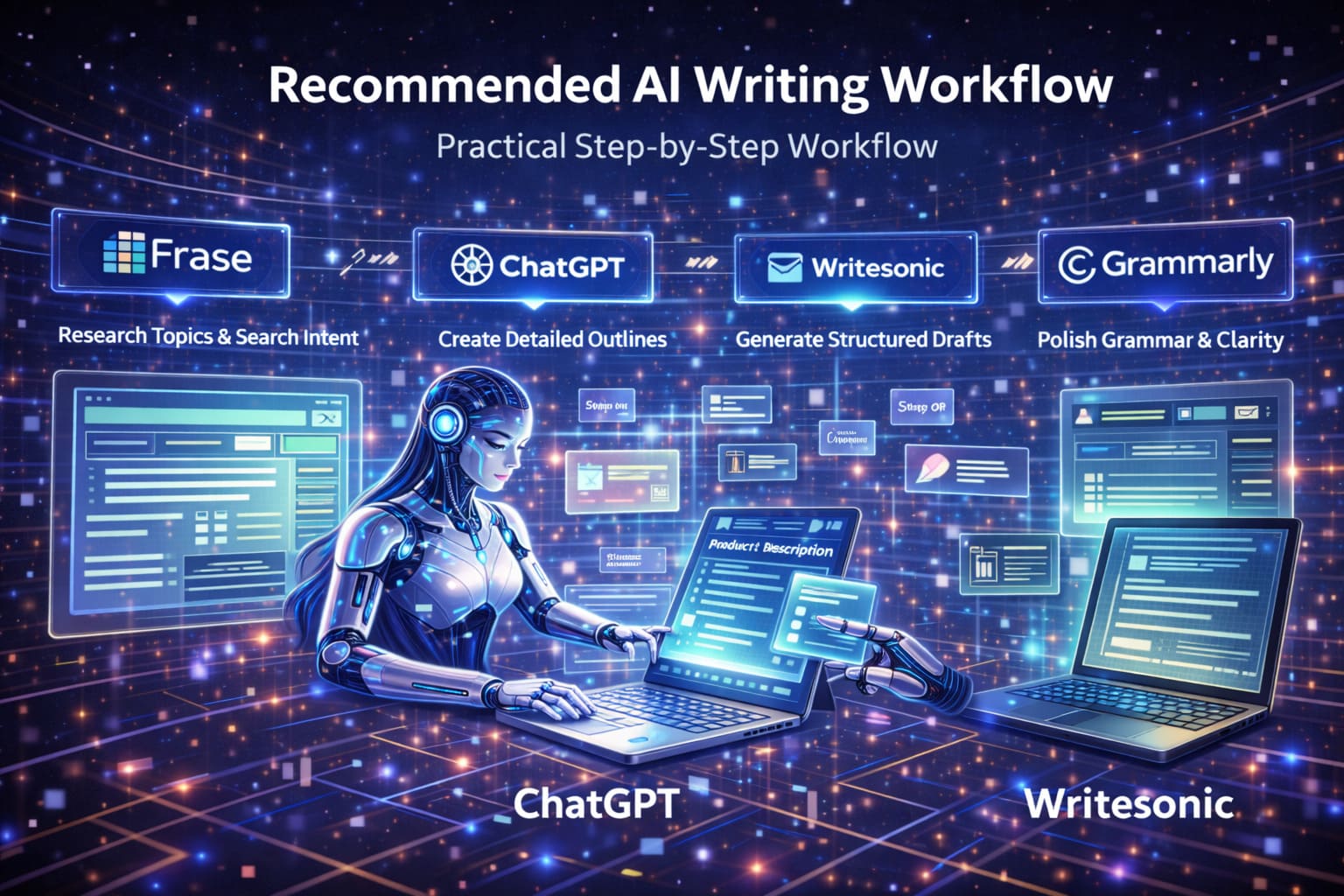
Using AI effectively requires a clear workflow. Relying on a single tool often leads to generic results, while combining tools strategically produces higher-quality content.
Practical Step-by-Step Workflow
- Research topics and search intent using Frase or manual SERP analysis
- Create detailed outlines with ChatGPT
- Generate structured drafts using ChatGPT or Writesonic
- Manually refine logic, examples, and flow
- Polish grammar, clarity, and tone with Grammarly
This workflow ensures efficiency without sacrificing originality or depth.
Common Mistakes When Using AI Writing Tools
Despite their advantages, AI writing tools can harm content quality if misused.
- Publishing AI-generated content without editing
- Trusting AI output without fact-checking
- Overusing repetitive phrases and patterns
- Failing to add personal insight or experience
Readers and search engines can easily detect low-effort AI content.
AI Writing Tools and SEO Best Practices
AI can support SEO, but rankings are driven by usefulness, clarity, and intent matching—not automation alone.
SEO Guidelines When Using AI
- Maintain clear heading hierarchy (H1 → H2 → H3 → H4)
- Use keywords naturally and sparingly
- Answer real user questions in depth
- Focus on helpful, original explanations
Further reading: Google AI and the Future of Search
Ethical and Copyright Considerations

AI writing tools generate text based on patterns, not understanding. Writers remain fully responsible for the final content they publish.
- Always review for originality
- Verify facts and claims
- Avoid publishing raw AI output
Responsible AI usage builds trust with readers and long-term credibility with search engines.
Frequently Asked Questions (FAQ)
Yes, AI writing tools are generally safe to use for blogs and academic content when used responsibly. Writers should always review, edit, and fact-check AI-generated text to ensure accuracy, originality, and alignment with ethical guidelines.
No, AI writing tools are designed to assist rather than replace human writers. They help with efficiency, structure, and clarity, but human judgment, creativity, and experience remain essential for producing meaningful and trustworthy content.
AI-generated content is not automatically considered plagiarism, but it must be reviewed carefully. Writers should rewrite, personalize, and add original insights to ensure the final content is unique and does not unintentionally mirror existing sources.
For beginners, tools like ChatGPT and Grammarly are often the easiest to start with. They offer simple interfaces, flexible use cases, and helpful guidance for drafting and editing without requiring advanced technical knowledge.
Yes, many AI writing tools can support SEO by helping structure content, improve readability, and align articles with search intent. However, successful SEO still depends on human-led keyword strategy, internal linking, and content quality.
Publishing AI-generated content without editing is not recommended. Raw AI output may contain inaccuracies, repetitive phrasing, or lack context. Editing ensures the content remains accurate, original, and aligned with your brand voice.
Writers can maintain their unique voice by using AI for structure and efficiency while personally refining tone, examples, and insights. Treat AI as a drafting assistant, not the final author.
Conclusion: Writing Smarter Without Losing Your Voice
AI writing tools are not here to take creativity away from human writers—they exist to protect it. In a world where speed often pressures quality, these tools offer something valuable: time to think, space to refine
For more in-depth guides on AI, productivity, and digital tools, visit: ByteToLife.com.