

Customer support used to mean long queues, robotic IVR menus, and agents juggling more tickets than any human should handle.
Today, something very different is happening behind the scenes. Artificial intelligence is quietly rewiring the entire contact center
stack – from how customers reach you, to how agents respond, to how leaders make decisions about experience and operations.
If you’ve ever received an instant answer from a chat widget, heard a surprisingly natural “robot” on the phone, or received a neat
summary email after a support call, there’s a good chance an AI-powered contact center was involved. This article is an
evergreen, pillar-style guide for readers of ByteToLife.com who want to understand how intelligent support really works,
why it’s trending, and how to adopt it in a practical, human-friendly way.
What Is an AI-Powered Contact Center?
An AI-powered contact center is a support organization where artificial intelligence plays an active role in handling,
assisting, or orchestrating customer interactions across channels like phone, chat, email, messaging apps, and social media.
Instead of relying purely on human agents plus simple rule-based scripts, AI contact centers use:
- Natural Language Processing (NLP) to understand what customers say or type.
- Generative AI / large language models to craft human-like, context-aware replies.
- Voicebots to replace rigid “press 1, press 2” IVR experiences with natural conversation.
- Intelligent routing engines that send each contact to the best agent, bot, or workflow.
- Real-time analytics and sentiment analysis to measure emotions and detect frustration early.
- Automation of after-call work, such as note-taking, tagging, and logging into CRM systems.
The goal is not simply to “replace humans with bots”. Instead, the core idea is to augment the support function with
systems that are fast, scalable, consistent, and available 24/7, while keeping humans for complex, emotional, or high-stakes cases.
Why AI Contact Centers Are Quietly Taking Over
Search interest and investment around AI contact centers have grown rapidly. That’s not a coincidence. Customer expectations,
business constraints, and AI capabilities all converged at the same time, creating a perfect adoption moment.
1. Customers Expect Instant, Frictionless Support
Modern customers live in a world of on-demand everything: streaming, ride-hailing, same-day delivery. Waiting 30 minutes in a call
queue or waiting days for an email response feels completely out of sync with their daily experience. AI allows brands to:
- Answer repetitive questions instantly via chat and voicebots.
- Offer self-service flows that genuinely work instead of looping dead-end FAQs.
- Keep support available 24/7 without hiring overnight teams in every timezone.
When the basic questions are handled automatically, human agents can give more attention to tricky or sensitive cases that truly
need a human touch.
2. Support Costs Are Under Extreme Pressure
Hiring, onboarding, and retaining support agents is expensive. Turnover can be high, training cycles are long, and
contact volume can spike unpredictably. AI acts like an elastic layer that absorbs:
- Seasonal spikes in chat and email volume.
- Repetitive Tier-1 interactions such as “Where is my order?” and “How do I reset my password?”.
- Routine verification and data entry tasks that agents used to do manually.
Instead of replacing the entire workforce, AI lets teams scale intelligently: fewer new hires for the same or higher volume,
and more budget freed for strategic CX improvements instead of constant firefighting.
3. AI Technology Finally Caught Up
Early chatbots were frustrating: they followed strict keyword rules, didn’t understand nuance, and often ended up escalating
everything to humans anyway. Modern AI contact centers use large language models and advanced NLP, which can:
- Handle messy, incomplete, or emotional phrasing.
- Maintain context across multiple turns in a conversation.
- Adapt tone depending on the user’s language and sentiment.
This shift from keyword bots to conversational AI is a big reason why companies are confident enough to put AI on the front line.
4. Data and Insight Are Now a Competitive Advantage
Traditional call centers only sampled a small fraction of conversations for QA. AI contact centers can analyze
100% of interactions, turning support into a goldmine of insight. This allows brands to:
- Spot product issues earlier based on recurring complaints.
- Understand which promises in marketing are not matching reality.
- Identify high-value customers who need proactive outreach.
Support is no longer just a cost center; with AI, it becomes a strategic feedback engine for the entire business.
Core Building Blocks of an AI Contact Center
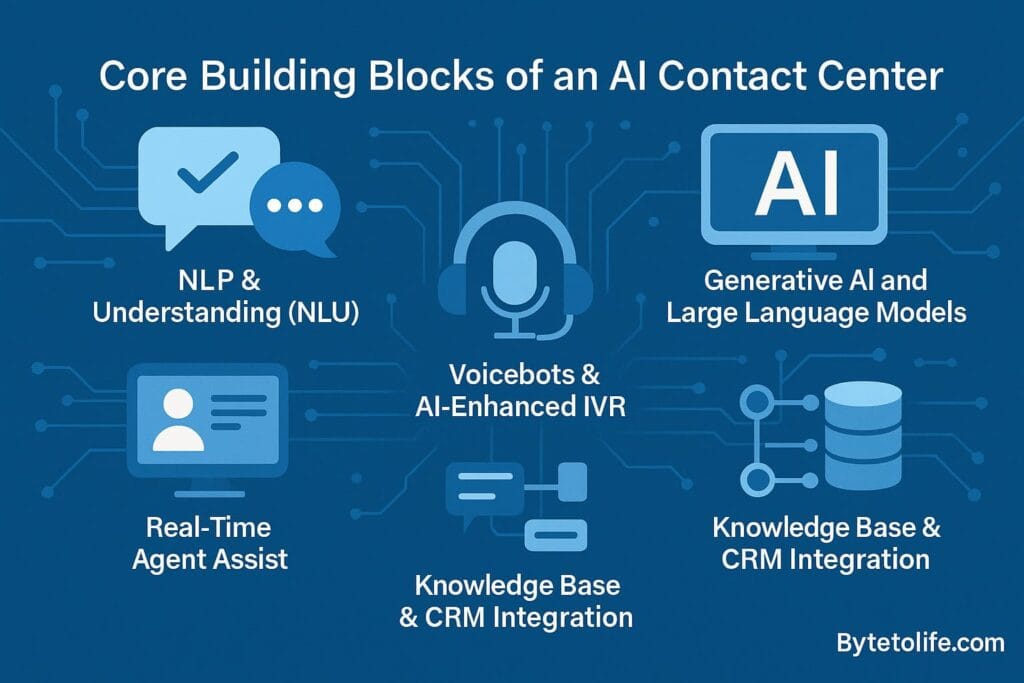
Under the hood, most AI contact centers rely on a similar set of ingredients. The way you combine them will depend on
your tools, size, and industry, but the building blocks are fairly consistent.
1. Natural Language Processing (NLP) and Natural Language Understanding (NLU)
NLP and NLU handle the core challenge: understanding what customers are trying to say. This includes:
- Extracting intent (e.g., “refund”, “technical issue”, “change address”).
- Identifying entities (order IDs, email addresses, product names).
- Handling spelling mistakes, slang, and multi-language input.
Good NLP makes the difference between a frustrating “I don’t understand” loop and a smooth, intelligent conversation.
2. Generative AI and Large Language Models
Once the system knows what the customer wants, generative AI takes over to craft the response. Unlike old scripts, generative AI:
- Combines policy, knowledge base content, and context into a natural reply.
- Can rephrase explanations depending on the user’s level of expertise.
- Supports multiple channels – the same engine can drive chat, email drafts, or in-app messages.
With the right guardrails, you can keep answers accurate and compliant while still feeling conversational.
3. Voicebots and AI-Enhanced IVR
Voicebots bring these capabilities into phone calls. Instead of forcing customers to “press 3 for billing”, they allow open speech:
“I need help with a wrong charge on my last invoice.”
The system parses that request, confirms details, and either resolves the issue or routes the call to a human with all relevant
context attached. Platforms like
Google Contact Center AI and
Amazon Connect support this kind of experience out of the box.
4. Intelligent Routing Engines
In an AI-powered contact center, routing can be much smarter than “next available agent”. Routing engines can factor in:
- Customer’s history and current sentiment score.
- Purchase value or account tier.
- Topic complexity and agent skill profiles.
- Current queue, SLAs, and channel-specific performance.
The result is a better match between each customer and the person or system most likely to solve their problem quickly.
5. Real-Time Agent Assist
AI doesn’t only help customers; it also supports agents while they’re working. Real-time assist tools can:
- Suggest answers while the agent is still reading the customer message.
- Surface relevant knowledge base articles and policy snippets automatically.
- Highlight risky phrases or potential compliance issues in real time.
Instead of expecting agents to memorize every product detail, you give them a “second brain” that sits beside them on every call.
6. Knowledge Base and CRM Integration
AI contact centers are only as good as the information they sit on. Integrations with CRM, billing systems, and knowledge bases enable:
- Instant lookup of customer history, preferences, and previous issues.
- Accurate updates to account data without manual data entry.
- Consistent answers, even as policies and products evolve.
This is where AI contact centers connect deeply with the broader digital productivity landscape you’ve seen in
articles like AI Tools Transforming Office Tasks
and What Is Digital Labor? on ByteToLife.com.
High-Impact Use Cases You Can Implement Today

You don’t have to rebuild your entire support operation overnight. Many organizations start with a few high-impact use cases that
show value quickly and de-risk the investment.
1. Tier-1 FAQ and Account Self-Service
Common scenarios include:
- Order status checks and delivery updates.
- Billing and invoice questions.
- Basic product troubleshooting.
- Account profile changes (address, email, password reset flows).
These questions are predictable and repetitive – perfect for AI to handle end to end.
2. Automated Ticket Triage and Categorization
Even if you want agents to answer everything, you can still use AI to:
- Classify tickets into the right queues or priority levels.
- Extract key entities (product, platform, region).
- Auto-assign tags for reporting and analytics.
This makes your support system cleaner and your reports more accurate.
3. Agent Assist for Email and Chat
Instead of writing every response from scratch, agents can use AI to draft replies in seconds and then review and personalize them.
This approach:
- Boosts productivity without losing human oversight.
- Keeps tone and policy consistent across a large team.
- Reduces fatigue from constant typing and rewriting.
4. Post-Call Summaries and CRM Updates
After a call, AI can generate:
- A clear summary of what the customer wanted.
- Actions taken and next steps agreed upon.
- Tags and fields to update in your CRM.
What used to take a few minutes per interaction can happen in seconds, giving agents more time for actual conversations.
5. Fraud, Abuse, and Deepfake Detection
As AI makes it easier for attackers to create deepfake voices and social engineering scripts, contact centers become a critical
defense layer. By analyzing patterns in speech, behavior, and context, AI can:
- Flag unusual account access requests.
- Detect signs of scripted or synthetic speech.
- Alert agents when something feels off before sensitive actions are approved.
This connects directly with the broader cybersecurity landscape discussed in
AI Voice Phishing & Deepfake Vishing Guide.
What You Can Actually Measure: Business Benefits and KPIs
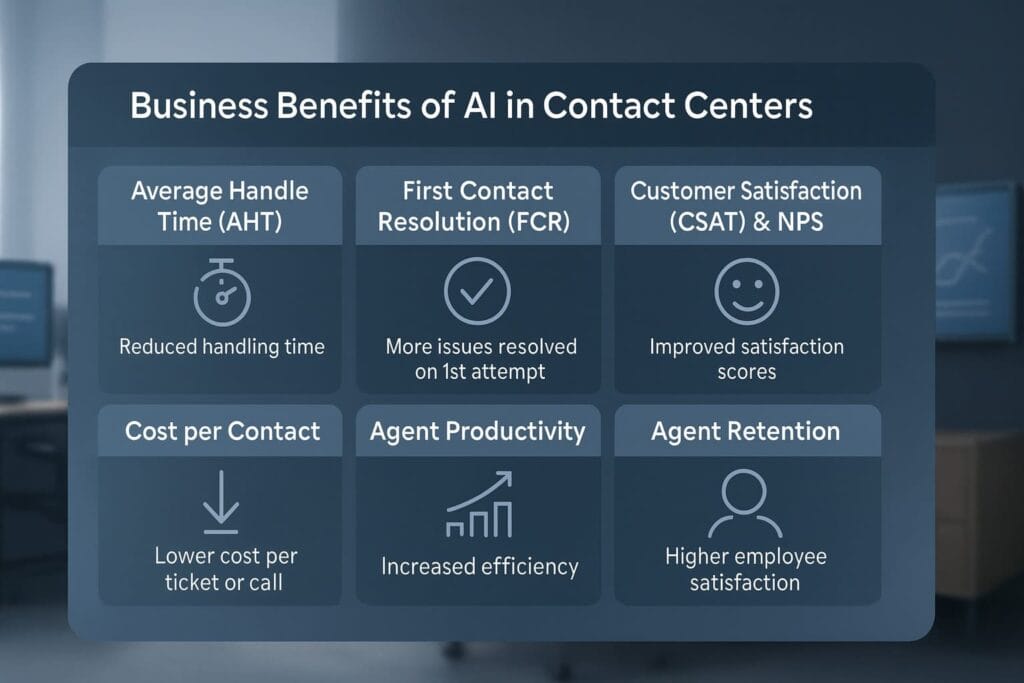
AI hype is everywhere, but contact centers are one of the rare areas where you can connect AI to practical, hard metrics.
- Average Handle Time (AHT) – AI drafts responses and provides instant context, reducing handling time per ticket or call.
- First Contact Resolution (FCR) – With better knowledge access and automation, more issues are solved in one interaction.
- Customer Satisfaction (CSAT) and NPS – Faster responses and fewer handoffs usually improve satisfaction scores.
- Cost per Contact – As automation handles more volume, cost per ticket or call can drop significantly.
- Agent Productivity and Retention – Less repetitive work means happier, more stable teams.
When you launch an AI-powered initiative, designing clear before/after metrics will make it easier to prove value and secure
further investment.
Risks, Limitations, and Ethical Considerations
No technology is neutral. AI in contact centers affects real people, in real time, often during stressful situations. That makes
ethics and limitations especially important.
1. Transparency: Customers Deserve to Know
It’s good practice to clearly communicate when people are speaking with an AI system and when they are speaking with a human.
Hiding AI behind a fake “agent persona” can damage trust if customers discover the truth later.
2. Privacy and Data Security
Support conversations often include personal or financial information. AI systems should:
- Store and transmit data using strong encryption.
- Mask sensitive fields where possible.
- Comply with regulations relevant to your region and industry.
3. Bias and Fair Treatment
AI models learn from data – and data can reflect human biases. It’s possible for AI routing or prioritization logic to unintentionally
favor or harm certain groups. Regular audits, diverse training data, and human review help reduce such risks.
4. Over-Reliance on Automation
It’s tempting to automate everything once the tools are in place. But not every conversation should be automated. Situations involving
health scares, financial distress, or complex disputes still benefit from patient human listening. The best AI contact centers know
when to hand over to a human – and make that transition smooth.
How to Implement an AI-Powered Contact Center: A Practical Roadmap
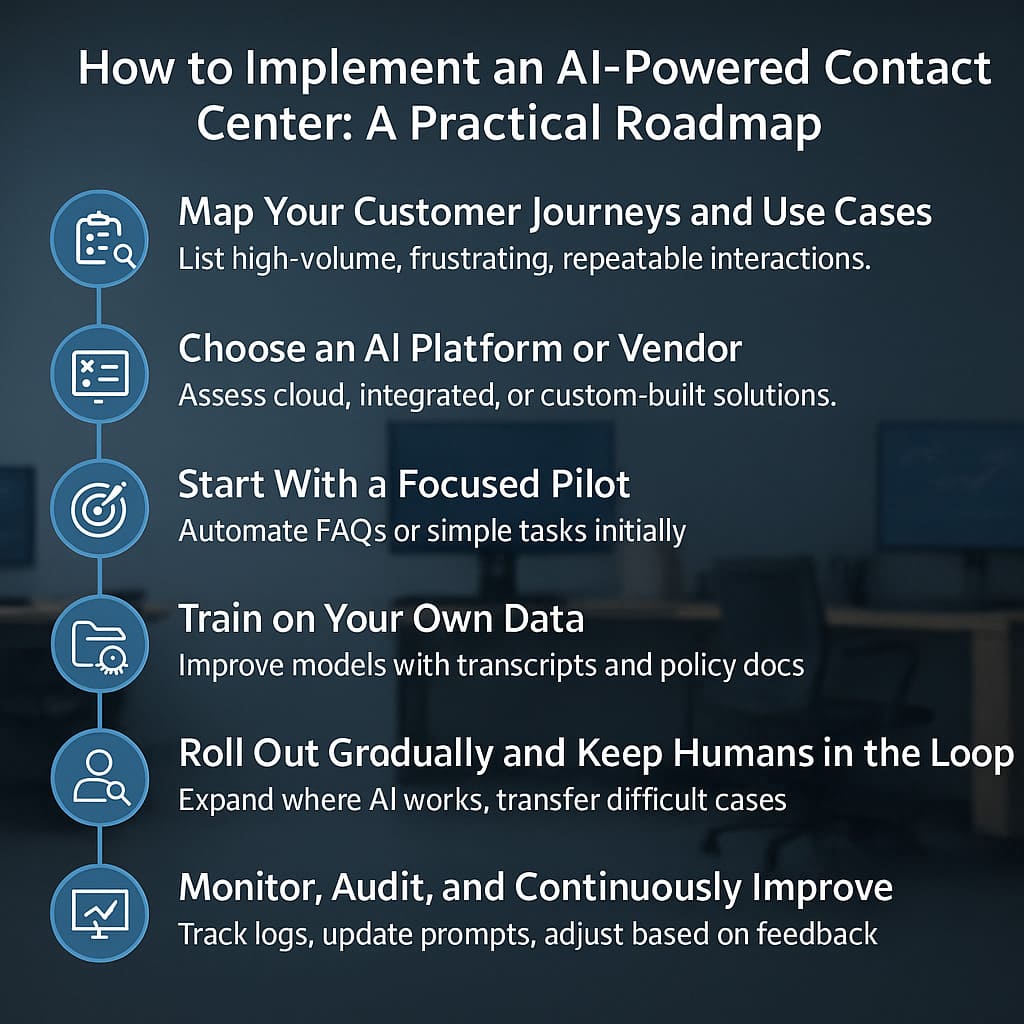
If you’re planning to move from traditional support to an AI-enhanced model, you don’t need to do it all at once. A phased,
ROI-driven approach works best.
Step 1: Map Your Customer Journeys and Use Cases
Start by listing:
- Your highest-volume contact reasons.
- Where customers get most frustrated.
- Which interactions have clear, repeatable steps.
These are top candidates for automation or AI assistance.
Step 2: Choose an AI Platform or Vendor
Depending on your stack, you might:
- Use a cloud contact center like Amazon Connect.
- Integrate AI into an existing telephony or helpdesk platform.
- Build a custom stack with APIs from multiple providers.
Look for platforms that support omnichannel, have good documentation, and integrate with your CRM of choice.
Step 3: Start With a Focused Pilot
Instead of “doing AI everywhere”, pick one area such as:
- FAQ chat automation on your website.
- Simple order-tracking voicebot for phone calls.
- AI email drafts for the billing team.
Define clear success metrics and timeframes, then review results and customer feedback honestly.
Step 4: Train on Your Own Data
Out-of-the-box models are powerful, but they get much better when trained on:
- Your past support transcripts.
- Your actual knowledge base and policy docs.
- Real examples of “good” and “bad” replies.
This is where AI starts to sound like your brand and not like a generic tech demo.
Step 5: Roll Out Gradually and Keep Humans in the Loop
Expand automation where it works, and keep humans involved where stakes are high. Create clear escalation paths: AI should know
its limits and transfer gracefully when confidence is low.
Step 6: Monitor, Audit, and Continuously Improve
AI isn’t something you turn on once and then ignore. Assign owners who:
- Review conversation logs and edge cases.
- Update prompts and guardrails.
- Watch performance metrics and customer sentiment trends.
Treat your AI contact center as a living system that evolves with your business and your customers.
Best Practices for Human-Centered AI Support
- Design for escalation, not only automation. Make it easy for customers to reach a human when needed.
- Be honest about AI. Transparency builds trust, especially with tech-savvy users.
- Empower agents, don’t replace them. Train your team to work with AI tools like co-pilots, not competitors.
- Keep language simple. Even if AI can generate complex phrasing, clarity beats cleverness in support.
- Document everything. Policies, knowledge base content, and escalation rules should be explicit and up to date.
AI-Powered Contact Centers vs Traditional Call Centers
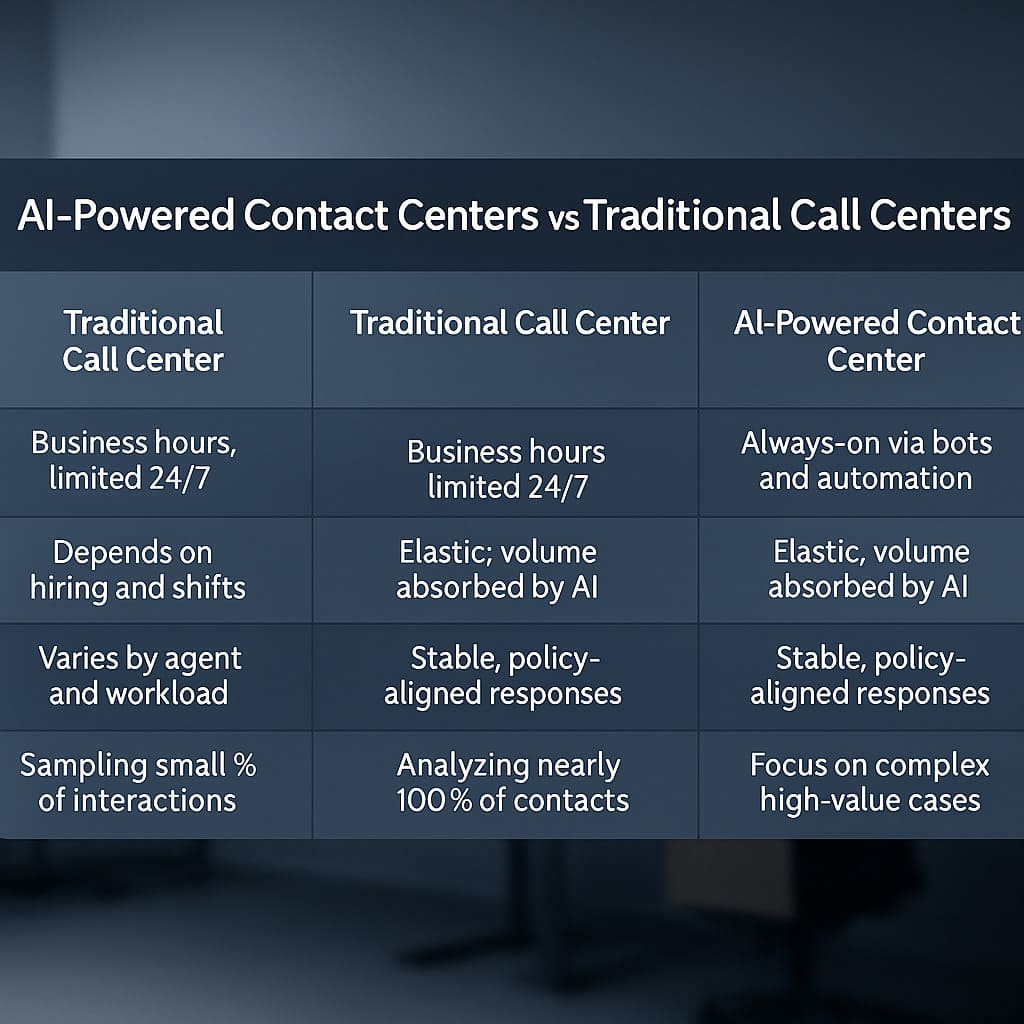
To summarize the shift, here’s a simplified comparison:
| Aspect | Traditional Call Center | AI-Powered Contact Center |
|---|---|---|
| Availability | Business hours, limited 24/7 | Always-on via bots and automation |
| Scalability | Depends on hiring and shifts | Elastic; volume absorbed by AI |
| Consistency | Varies by agent and workload | Stable, policy-aligned responses |
| Data Insight | Sampling small % of interactions | Analyzing nearly 100% of contacts |
| Agent Role | Handle everything manually | Focus on complex, high-value cases |
Frequently Asked Questions (FAQ)
The key is using AI to support — not replace — the human element. Companies should design their AI flows with
natural language, emotional awareness, and transparent escalation paths. This means allowing AI to handle routine
tasks, while humans focus on complex or sensitive situations. Fine-tuning tone, integrating CRM context, and
offering an easy “talk to a human” option ensure that automation enhances customer experience instead of
diminishing it.
Most organizations begin by automating predictable, rule-based, and low-risk interactions. These include order
status checks, billing clarifications, password resets, appointment reminders, and frequently asked questions.
Such tasks follow consistent patterns and require minimal human judgment, making them ideal for AI-driven flows.
Once these foundational workflows are stable, companies can expand into more advanced automation and intelligent
routing.
Modern AI contact centers use multiple layers of security: encrypted data channels, role-based access,
real-time redaction, secure APIs, and privacy-preserving model configurations. They can automatically mask
sensitive identifiers like credit card numbers or account details before processing. Regular audits, compliance
reviews, and strict retention controls ensure that AI systems process only what is necessary and do not store
sensitive information longer than needed.
Accuracy comes from controlling the AI’s information sources and enforcing guardrails. Companies should connect
the AI to verified knowledge bases, implement strict prompt rules, and limit improvisation on critical topics.
Human oversight remains essential: high-impact or policy-sensitive responses should require agent confirmation.
Continuous monitoring, testing, and refinement help eliminate hallucinations and ensure reliable support quality.
SMEs can adopt AI incrementally using built-in automation tools from their existing platforms (CRM, helpdesk,
cloud telephony). Many providers offer no-code or low-code AI features like automated triage, chatbot builders,
and workflow assistants. Starting with a narrow pilot—such as FAQ bots or AI-generated email drafts—helps reduce
risk while delivering quick wins. As the business grows, AI workflows can scale without major infrastructure
changes.
Signs include increased customer frustration, repeated attempts to bypass the bot, declining satisfaction scores,
or rising escalations for relatively simple issues. If customers feel stuck in loops or if AI frequently misroutes
cases, automation boundaries need reevaluating. A healthy contact center balances efficiency with empathy: AI
should reduce friction—not block access to real help.
Intelligent routing systems evaluate multiple signals simultaneously, such as customer sentiment, issue complexity,
purchase history, language preference, and the agent’s skills or past performance. They compute which combination
of human or automated resources will produce the fastest, most accurate resolution. Unlike traditional queue-based
routing, AI routing adapts dynamically to real-time context and business priorities.
Ethical deployment requires transparency, fairness, and responsible use of personal data. Customers should know
when they are talking to an AI system, and the bot’s behavior must follow clear boundaries that prevent manipulation
or bias. Sensitive or emotionally complex cases must be escalated promptly to trained agents. Continuous ethical
reviews help ensure that the system remains trustworthy as it evolves.
AI can replace purely repetitive or procedural tasks, but humans remain essential for empathy-driven, sensitive, or
judgment-heavy interactions. The strongest contact centers operate as hybrid systems where automation handles efficiency,
and humans provide emotional intelligence. Rather than replacement, the future is a collaboration where each side does
what it does best.
Beyond cost savings, AI-powered contact centers unlock richer insights into customer behavior, reveal emerging product
issues, enhance forecasting accuracy, and streamline cross-department collaboration. Over time, these systems evolve
into intelligent experience hubs that influence product design, marketing strategy, operational planning, and customer
lifecycle management. AI becomes not just a support tool, but a strategic asset that elevates the entire business.
Conclusion: From Call Center to Intelligent Experience Hub
AI-powered contact centers are far more than a technological upgrade — they represent a complete rethinking of how businesses build,
deliver, and sustain customer relationships. What began as a tool to automate repetitive tasks has evolved into an intelligent layer
that enhances every touchpoint of the support journey. Instead of reacting to problems as they appear, companies can now design
proactive experiences, anticipate customer needs, and resolve issues before they escalate. This shift moves contact centers from
being cost-heavy operational units into strategic hubs of insight and value creation.
Crucially, AI does not diminish the importance of human agents; it magnifies it. By absorbing high-volume, low-impact tasks,
AI frees agents to focus on the complex, emotional, and high-stakes interactions where human empathy makes the biggest difference.
In this new model, humans and machines complement each other naturally — AI provides speed, accuracy, and consistency, while humans
offer nuance, compassion, and judgment. The result is a support ecosystem that feels more caring, more responsive, and more aligned
with modern customer expectations.
For readers of ByteToLife.com, this evolution is deeply connected to broader themes surrounding digital productivity, AI assistants,
and the emergence of intelligent digital labor. Contact centers serve as a real-world example of how AI transitions from theory to
practical impact — not as a futuristic idea, but as a system delivering measurable improvements today. They illustrate how automation
and human expertise can coexist in balance, shaping new workflows and redefining what “customer experience” actually means.
As AI continues to advance, we will see contact centers become even more predictive, more personalized, and more tightly integrated
with the rest of the business. Future systems may analyze customer behavior in real time, coordinate across departments, and even
proactively initiate support outreach before a customer asks for help. What was once a passive service department is slowly becoming
an intelligent, data-driven nerve center — influencing product decisions, marketing messages, and overall business strategy.
Ultimately, the transformation of contact centers reflects a larger truth: the future of work is not about replacing people,
but empowering them. AI will quietly take over the repetitive, high-volume tasks that drain time and energy, while humans step
into roles that require deeper thinking, creativity, and emotional intelligence. Businesses that embrace this hybrid model will
deliver richer customer experiences, operate more efficiently, and stay competitive in a world where expectations continue to rise.
The shift from call center to intelligent experience hub is already underway. Brands that adopt AI thoughtfully — focusing on
transparency, empathy, and purposeful automation — will not only improve service but redefine what exceptional customer support
can look like. And for those building the digital future, like the readers of ByteToLife.com, this space offers one of the clearest
and most exciting examples of how AI can elevate human capability rather than replace it.